Where the idea began
The 2010 lavafall behind the show
How an eruption on the Fimmvörðuháls pass in March 2010 became a live lava show, from the first idea to the Vík and Reykjavík venues.
Reserve your Lava Show seat ↗An eruption on a hiking pass
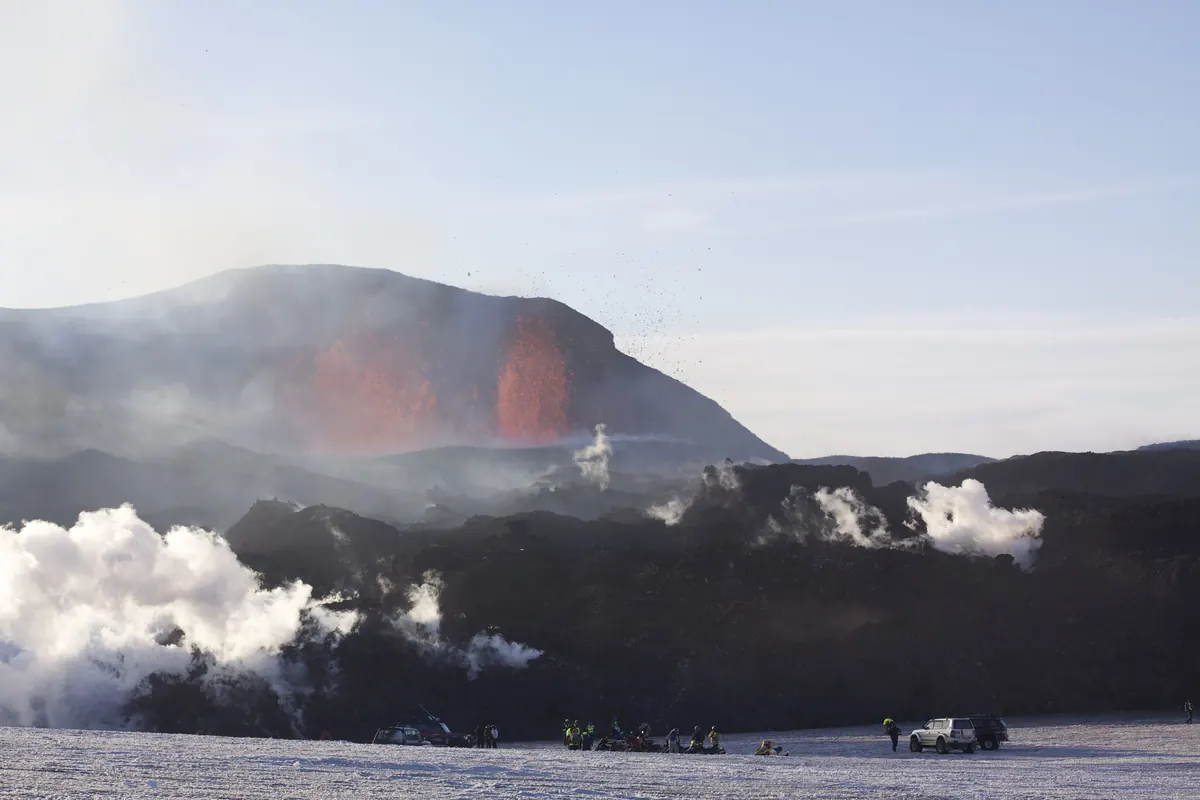
The Fimmvörðuháls eruption began on 20 March 2010, about 8 km east of the summit crater of Eyjafjallajökull. Fimmvörðuháls is the pass between the Eyjafjallajökull and Mýrdalsjökull glaciers. Wikipedia describes a radial fissure about 300 m long, with 15 lava fountains reaching up to 185 m. The fissure opened on the north side of the pass, across the hiking trail between Skógar and Þórsmörk. It did not form under the glacier and was smaller than some geologists had expected.
A lavafall that started a company
The Lava Show's founders say the idea came to them in 2010, while they watched this eruption in South Iceland. What caught their attention was a glowing lavafall pouring about 200 metres down a cliffside. It happened a few weeks before the better-known Eyjafjallajökull eruption. The Eyjafjallajökull eruption that followed disrupted air travel across northwest Europe.
Years of building
The idea did not become a show quickly. The company says the project restarted in early 2016, with the aim of building the world's first live lava show. The first Lava Show opened in Vík in 2018. A second venue followed in Reykjavík's Grandi harbour district in 2022. That makes the show a recent attraction, shaped by one landscape moment rather than a long tradition. Its news page marked the company's eighth anniversary on 3 September 2026, a date that fits an opening in 2018.
The summit eruption that followed
The Fimmvörðuháls eruption was followed by a much bigger one. From 14 April 2010 the volcano erupted again from its top crater, in the middle of the glacier. Wikipedia says it was explosive because meltwater entered the vent, and estimates it as 10 to 20 times larger than the first eruption. Ash rose several kilometres and disrupted air travel across northwest Europe for six days, from 15 to 21 April. Meltwater floods hit nearby rivers, and about 800 people were evacuated.
From eruption to showroom
The show recreates a volcanic eruption indoors. The company uses real Icelandic lava rock, which it says comes from the 1918 Katla eruption, heats and melts it, and pours it into a showroom where visitors watch from close range. A host explains what you see. It is a controlled demonstration, not a live eruption, which is why the lava can be shown safely in front of a seated audience and why weather does not affect it. The venue's blog adds that real eruptions are unpredictable and often out of reach.
Seeing the original site
Fimmvörðuháls is a hiking pass between two glaciers, and the 2010 eruption there is long over. Hiking routes in the highlands depend on weather and conditions, and Safetravel, run by the Icelandic Association for Search and Rescue, publishes current conditions and alerts. Wikipedia places the Fimmvörðuháls trail between Skógar and Þórsmörk. Treat any highland route as a serious undertaking rather than a stroll. Never walk on fresh lava fields, which can stay dangerously hot for years, because hidden cracks and thin crusts can conceal very hot or still-molten rock. Follow trail closures and barriers at any eruption site.
Who this isn't for
If you are looking for the original Fimmvörðuháls site, this is not it: the pass is a hiking route and the eruption is long over. If you want a documentary on the 2010 eruptions, the show gives a short film and a talk, not a full account. And if you prefer your volcanoes outdoors, the show will feel like a stage version of something much larger.
Sources